Quantum Computing Infrastructure: Hardware, Cloud Platforms and Engineering Workflows
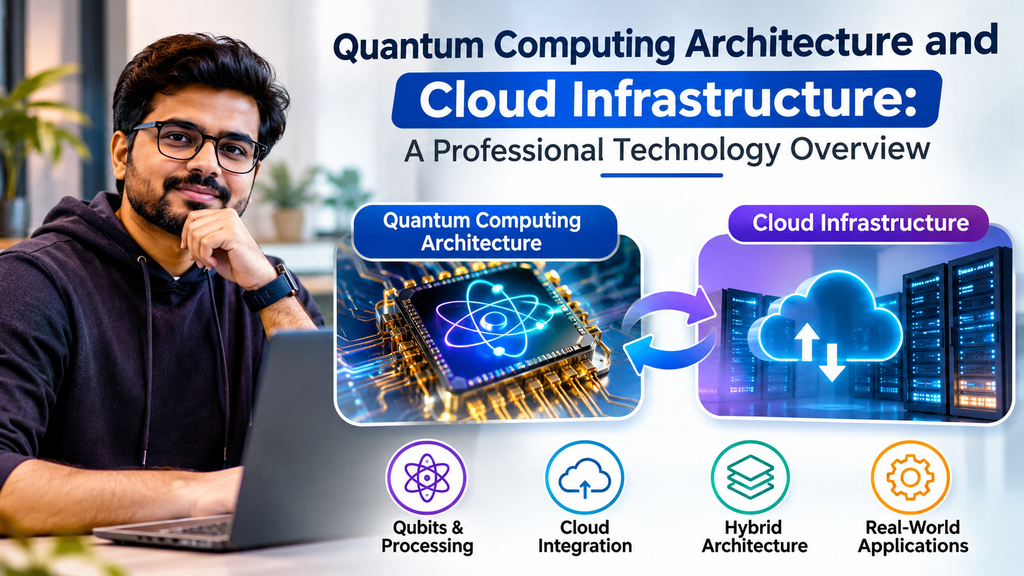
1. Introduction: Understanding the Infrastructure Behind Quantum Computing
Quantum computing is changing how researchers and technology professionals explore complex computational problems. Unlike traditional computers, quantum computers use quantum bits, commonly called qubits, to represent and process information.
However, a quantum computer does not work like a regular desktop or server. It requires specialised physical systems, precise control mechanisms, measurement devices, software frameworks, and supporting classical computers.
A complete quantum computing environment includes several important components:
- Quantum processors that contain physical qubits.
- Control systems that operate quantum hardware.
- Measurement systems that collect quantum results.
- Software frameworks that build quantum circuits.
- Simulators that test circuits without physical hardware.
- Cloud platforms that provide remote access.
- Classical systems that prepare data and process results.
These components work together to execute quantum experiments.
For example, a developer may create a quantum circuit using a programming framework. The developer can run that circuit on a simulator or submit it to a supported quantum processor through a cloud platform.
The cloud service manages the execution process and returns measurement results.
Understanding this complete environment helps developers, architects, engineers, and IT managers make better technical decisions.
2. What Makes Quantum Computing Infrastructure Different?
Traditional computing infrastructure mainly uses classical bits. A classical bit represents either zero or one.
Quantum computing uses qubits. A qubit can exist in a quantum state that combines the possibilities of zero and one.
This behaviour is called superposition.
Quantum systems can also use entanglement. Entangled qubits can share correlations that classical systems cannot reproduce through ordinary independent bit states.
Quantum gates change qubit states. Measurements produce classical results that developers can analyse.
These principles require specialised infrastructure.
2.1 Quantum processors
A quantum processor contains physical qubits.
Different technologies can create and control qubits in different ways.
Common approaches include:
- Superconducting circuits.
- Trapped ions.
- Neutral atoms.
- Photonic systems.
- Spin-based systems.
Each approach has different engineering requirements and operating characteristics.
2.2 Control systems
Quantum processors require precise operations.
Control systems generate signals that manipulate physical qubits. Their design depends on the underlying hardware technology.
For example, superconducting quantum processors commonly operate at extremely low temperatures. Their infrastructure includes specialised cryogenic equipment and microwave control electronics.
Trapped-ion systems use electromagnetic fields and laser-based techniques to control ions.
2.3 Measurement systems
Quantum algorithms eventually produce measurement results.
A measurement converts quantum information into classical output.
Developers usually execute circuits multiple times, often called shots, to estimate the output probabilities.
The quality of these results depends on the processor, circuit, measurement process, and execution conditions.
2.4 Classical computing support
Quantum computers still depend heavily on classical computing.
Classical systems handle programming, data preparation, optimisation, job management, result analysis, and application integration.
This is why modern quantum infrastructure often uses a hybrid architecture.
3. Explore the Main Types of Quantum Hardware
Different quantum hardware technologies use different physical systems to represent qubits.
Understanding these approaches helps professionals evaluate quantum platforms.
3.1 Superconducting quantum processors
Superconducting processors use electrical circuits that behave as quantum systems.
They commonly operate at temperatures close to absolute zero.
Specialised refrigeration systems maintain the required operating conditions.
Important characteristics:
- Fast gate operations.
- Sophisticated microwave control.
- Cryogenic infrastructure requirements.
- Sensitivity to noise and environmental disturbances.
- Engineering challenges involving connectivity and scaling.
Superconducting technology is one of the major approaches used in quantum processor development.
3.2 Trapped-ion quantum processors
Trapped-ion systems use electrically charged atoms called ions.
Electromagnetic fields hold the ions in place. Laser-based systems manipulate their quantum states.
Important characteristics:
- Highly controlled individual ions.
- Strong connectivity possibilities in certain architectures.
- Laser and vacuum system requirements.
- Different gate-speed and scaling trade-offs compared with superconducting systems.
Trapped-ion processors provide another important approach to quantum information processing.
3.3 Neutral-atom quantum processors
Neutral-atom systems use electrically neutral atoms as qubits.
Researchers can arrange and manipulate these atoms using specialised optical systems.
Some architectures use optical tweezers and interactions between excited atomic states.
These systems are attracting interest for scalable quantum processor research.
3.4 Photonic quantum computing
Photonic systems use particles of light to represent and process quantum information.
They offer a different engineering approach from systems that use stationary physical qubits.
Their development involves specialised optical components, photon sources, detectors, and circuit designs.
3.5 Why hardware differences matter
A quantum algorithm may behave differently across different hardware platforms.
The available gates, connectivity, noise characteristics, and execution constraints affect how developers design circuits.
Therefore, choosing a quantum backend requires technical evaluation.
A professional should understand the problem before selecting a processor.
4. Quantum Cloud Computing Training: Accessing Quantum Infrastructure Remotely
Quantum cloud computing training teaches learners how to access quantum computing resources through online platforms.
This is useful because individuals and organisations do not need to own a physical quantum processor to begin learning.
Cloud environments provide access to development tools, simulators, and selected quantum hardware.
4.1 Understand the cloud computing model
A typical quantum cloud workflow includes:
- Create a development environment.
- Write a quantum circuit.
- Select a simulator or supported hardware backend.
- Configure the execution settings.
- Submit the quantum job.
- Wait for the execution result.
- Review and analyse the output.
The cloud platform manages the communication between the development environment and the selected resource.
4.2 Learn quantum simulators
Simulators allow developers to test quantum circuits without using physical quantum hardware.
They are useful for:
- Learning quantum gates.
- Testing circuit logic.
- Understanding measurement probabilities.
- Debugging circuit construction.
- Comparing expected and observed behaviour.
A simulator does not automatically reproduce every physical hardware limitation.
Developers should distinguish ideal simulation from realistic noisy simulation.
4.3 Learn real hardware execution
After testing a circuit, developers may submit it to supported quantum hardware.
They should review the device’s gate set, connectivity, availability, and execution requirements.
Physical hardware may produce noisy results.
Learners should record the backend and experiment settings so they can understand the results later.
4.4 What a good training programme should teach
A practical quantum cloud computing training programme should include:
- Quantum fundamentals.
- Circuit programming.
- Simulator access.
- Cloud authentication.
- Backend selection.
- Job submission.
- Measurement analysis.
- Resource management.
- Experiment documentation.
Training should include hands-on exercises rather than only theoretical explanations.
5. Quantum Computing Certification Course: Developing Structured Technical Knowledge
A quantum computing certification course can help learners develop knowledge through a structured curriculum.
It may suit software engineers, cloud professionals, researchers, architects, and technology managers.
However, learners should select a programme based on its actual content.
5.1 Core subjects to study
A detailed curriculum may include the following areas.
Quantum fundamentals: Learn qubits, superposition, entanglement, measurement, and quantum states.
Quantum mathematics: Understand complex numbers, vectors, matrices, and basic linear algebra.
Quantum gates: Study common gates such as X, Y, Z, Hadamard, and CNOT.
Quantum circuits: Learn how gates combine to create quantum algorithms.
Quantum algorithms: Explore selected algorithms and understand the problems they address.
Quantum hardware: Understand different processor technologies and their limitations.
Cloud platforms: Learn how to access simulators and supported quantum devices.
Practical projects: Build, test, and document quantum experiments.
5.2 Understand the importance of practical assessments
A course should test whether learners can apply concepts.
For example, an assessment might ask learners to build a circuit that creates a Bell state.
A learner can apply a Hadamard gate to the first qubit and then apply a CNOT gate, using the first qubit as the control.
In an ideal environment, repeated measurements produce correlated results: 00 and 11.
This exercise demonstrates how circuit operations create entanglement.
5.3 How to choose the right course
Before enrolling, review:
- Course syllabus.
- Trainer experience.
- Learning materials.
- Practical labs.
- Assessment methods.
- Project requirements.
- Certificate issuer.
- Certificate verification process.
A certificate’s recognition depends on its issuer and the relevant professional or industry requirements.
Do not assume that every quantum computing certificate has the same value.
6. QuantumOps Certification: Understanding Quantum Operations and Workflow Skills
QuantumOps certification is a specialised keyword associated with quantum operations learning.
The term suggests a focus on managing quantum development and experimentation workflows.
However, the exact syllabus, issuer, assessment, and recognition depend on the specific programme.
Learners should verify these details before making an enrolment decision.
6.1 What does quantum operations knowledge involve?
Quantum operations involve more than building a circuit.
A complete workflow may include:
- Preparing the development environment.
- Selecting a quantum framework.
- Creating quantum circuits.
- Running simulations.
- Selecting hardware backends.
- Submitting execution jobs.
- Collecting measurement results.
- Analysing output.
- Recording experiment settings.
These activities help teams manage quantum experiments in a structured way.
6.2 Learn experiment management
A professional should understand how to maintain accurate experiment records.
A useful record includes:
- Project name.
- Circuit version.
- Framework version.
- Backend information.
- Execution settings.
- Number of shots.
- Measurement results.
- Observed limitations.
This information makes it easier to reproduce and compare experiments.
6.3 Why operational skills matter
Quantum hardware can produce noisy results. Backend conditions and circuit execution settings can affect outcomes.
A structured workflow helps developers understand these differences.
It also supports teamwork between developers, researchers, cloud engineers, and architects.
6.4 Verify the certification programme
Before selecting a QuantumOps certification, check the provider’s official programme information.
Confirm the course content, assessment process, instructor qualifications, practical requirements, and certificate verification method.
Treat the programme as a learning option until its recognition has been independently established.
7. Qiskit Programming Course: Learning Quantum Software Development
Qiskit is an open-source framework for quantum computing.
Developers can use it to create quantum circuits, work with simulators, and interact with supported quantum computing services.
A Qiskit programming course provides a practical starting point for quantum software development.
7.1 Understand the development environment
Learners should first become familiar with Python.
They should understand variables, functions, lists, packages, and basic object-oriented programming.
These skills help them work with quantum development libraries.
7.2 Learn quantum circuit components
A quantum circuit uses several building blocks.
Quantum register: Holds qubits.
Classical register: Stores measured classical bits.
Quantum gate: Changes a qubit’s quantum state.
Measurement: Converts quantum information into classical output.
Circuit execution: Runs the circuit on a simulator or supported backend.
7.3 Create a simple superposition experiment
Consider a single qubit that starts in the zero state.
Apply a Hadamard gate.
The gate creates an equal superposition of zero and one.
When an ideal circuit measures the qubit repeatedly, the results approach an equal distribution.
This simple experiment helps learners understand quantum state preparation and measurement.
7.4 Learn circuit optimisation
Quantum hardware supports specific operations and connectivity patterns.
A transpiler adapts circuits to a backend’s requirements.
It may change gate representations, optimise operations, or insert SWAP gates to handle connectivity restrictions.
This makes transpilation an important part of real hardware execution.
7.5 Build a practical Qiskit project
A beginner project could include:
- Create a two-qubit circuit.
- Apply a Hadamard gate.
- Apply a CNOT gate.
- Measure both qubits.
- Run the circuit on a simulator.
- Review the measurement counts.
- Document the result.
This project introduces quantum circuit construction and entanglement.
8. AWS Braket Training: Working With Quantum Cloud Infrastructure
Amazon Braket is a managed AWS service for quantum computing.
It provides access to quantum development tools, simulators, and supported quantum hardware.
AWS Braket training helps developers understand how to create and execute quantum experiments through AWS.
8.1 Understand the service workflow
A typical workflow includes:
- Preparing an AWS environment.
- Accessing the required service permissions.
- Creating a quantum circuit.
- Selecting a supported device or simulator.
- Submitting a task.
- Reviewing the result.
- Recording execution information.
Developers should understand the relationship between their application and the selected quantum backend.
8.2 Explore supported simulators
Simulators help developers test circuits before using physical hardware.
They can support learning, debugging, and early algorithm development.
Some simulator options also allow developers to explore noise models.
8.3 Understand hardware access
Amazon Braket provides access to selected quantum hardware providers.
Device availability and capabilities vary.
Before submitting a task, review the device’s supported operations and execution constraints.
8.4 Learn hybrid jobs
Some quantum algorithms require repeated classical and quantum operations.
Amazon Braket supports hybrid jobs for workflows that combine classical processing with quantum tasks.
These workflows can help developers investigate algorithms that depend on classical optimisation loops.
8.5 Understand cost and access management
Cloud services may charge for different types of usage.
Developers should review current pricing and service conditions before running experiments.
IT teams should also configure suitable permissions, budget controls, and monitoring.
AWS Braket training should cover these operational topics alongside quantum programming.
9. Quantum Computing for Software Engineers: Building Quantum Applications
Software engineers can apply their existing programming knowledge to quantum development.
They do not need to abandon classical software engineering practices.
Instead, they learn how quantum components can work with traditional applications.
9.1 Learn the required foundations
A software engineer should study:
- Python programming.
- Linear algebra basics.
- Qubits and quantum states.
- Quantum gates.
- Circuit measurement.
- Quantum algorithms.
- Quantum software frameworks.
- Cloud execution.
A strong foundation makes advanced concepts easier to understand.
9.2 Understand application integration
A quantum application may contain several components.
For example:
Frontend: Collects user input and displays results.
Backend: Validates input and manages application logic.
Classical processing: Prepares data and calculates reference results.
Quantum service: Submits circuits to a simulator or supported hardware.
Result processing: Converts measurement data into useful output.
This architecture keeps quantum experimentation separate from normal application responsibilities.
9.3 Apply software engineering practices
Quantum projects still need good development practices.
Engineers should use:
- Version control.
- Automated testing.
- Code reviews.
- Dependency management.
- Logging.
- Error handling.
- Configuration management.
- Documentation.
These practices improve code quality and help teams reproduce experiments.
9.4 Build a portfolio project
A useful project could compare a classical algorithm with a small quantum experiment.
The project should explain the problem, circuit design, backend, measurement results, and limitations.
Do not claim quantum superiority unless the results support that conclusion.
10. Quantum Computing Architecture Course: Designing Complete Quantum Systems
A quantum computing architecture course helps learners understand how different infrastructure components connect.
It covers the relationship between hardware, software, cloud services, classical systems, and application workflows.
10.1 Study the main architecture layers
Application layer: Defines the business or research problem.
Classical computing layer: Prepares input data and manages traditional calculations.
Quantum programming layer: Creates circuits and algorithm configurations.
Execution layer: Selects a simulator or quantum processor.
Hardware layer: Contains the physical quantum processor and its control systems.
Measurement layer: Collects the results of quantum execution.
Monitoring layer: Tracks jobs, costs, errors, and experiment records.
These layers provide a useful way to understand a complete quantum environment.
10.2 Understand the data flow
A typical quantum workflow follows this sequence:
- An application receives a problem.
- Classical software prepares the input.
- A quantum framework creates the circuit.
- A backend receives the execution request.
- The simulator or processor runs the circuit.
- Measurement results return to the application.
- Classical software analyses the output.
- The system stores the experiment record.
The architecture should make these steps clear.
10.3 Study hardware connectivity
Quantum processors do not all provide unrestricted connectivity between qubits.
Some circuits require additional operations to work with a processor’s connectivity.
These changes can increase circuit depth and affect execution quality.
Architects should understand how backend constraints influence circuit design.
10.4 Learn reliability and monitoring
Quantum systems require careful monitoring.
Teams should record failed jobs, execution settings, backend information, and measurement results.
They should also understand how to handle unavailable devices and interrupted workflows.
10.5 Design for flexibility
Avoid tightly connecting a business application to one experimental quantum backend.
A separate execution service can manage backend selection and job submission.
This makes it easier to test different simulators or supported devices.
11. Hybrid Quantum Classical Computing Training: Understanding Combined Workflows
Hybrid quantum classical computing training teaches how traditional computers and quantum processors work together.
This approach is important because many quantum algorithms rely on classical calculations.
The classical computer often manages the larger workflow. The quantum processor performs selected circuit operations.
11.1 Understand the hybrid architecture
A hybrid system may contain:
- A classical application.
- A data preparation component.
- A quantum circuit.
- A quantum simulator or processor.
- A classical optimisation algorithm.
- A result analysis component.
Each component performs a specific task.
11.2 Understand the execution cycle
A typical hybrid workflow follows these steps:
- A classical program prepares initial parameters.
- The quantum circuit receives those parameters.
- The quantum system executes the circuit.
- The system measures the output.
- Classical software analyses the measurements.
- An optimiser updates the parameters.
- The workflow repeats.
The process continues until it reaches a defined stopping condition.
11.3 Study VQE
The Variational Quantum Eigensolver is a hybrid algorithm used to investigate suitable energy problems.
It combines a parameterised quantum circuit with a classical optimisation process.
The quantum circuit produces measurements. The classical optimiser uses the results to update circuit parameters.
Learners should understand the algorithm’s purpose, assumptions, and practical limitations.
11.4 Study QAOA
The Quantum Approximate Optimisation Algorithm is a hybrid method for selected combinatorial optimisation problems.
It uses parameterised circuits and classical optimisation.
The method requires an appropriate mathematical representation of the problem.
Its practical performance depends on the problem, circuit, hardware, and classical comparison.
11.5 Measure total execution requirements
A hybrid workflow may involve repeated quantum jobs.
Therefore, developers should measure:
- Classical processing time.
- Quantum execution time.
- Communication overhead.
- Number of circuit evaluations.
- Measurement quality.
- Cloud usage.
- Total experiment cost.
The full workflow matters more than one isolated processor measurement.
12. Quantum Computing Consulting Services: Planning Technical Infrastructure
Quantum computing consulting services can help organisations understand their technical requirements.
A company may need assistance with architecture planning, platform selection, feasibility studies, or prototype development.
Consulting can provide specialised knowledge when internal teams are still developing their skills.
12.1 Infrastructure assessment
A consultant may review the organisation’s current environment.
The assessment could examine:
- Existing cloud infrastructure.
- Programming languages.
- Development tools.
- Data systems.
- Security controls.
- Technical skills.
- Business requirements.
This helps identify what the organisation needs before starting an experiment.
12.2 Platform selection
Different quantum platforms have different capabilities.
A consultant can help compare supported hardware, simulators, programming frameworks, access models, and cost structures.
The selection should match the planned experiment.
12.3 Architecture design
A technical architecture should explain how classical and quantum components communicate.
It should identify the data flow, execution process, backend selection, authentication, monitoring, and result storage.
12.4 Proof-of-concept development
A consulting project may include a small working prototype.
The prototype should demonstrate a defined technical workflow.
It should also include test results, assumptions, limitations, and recommendations.
12.5 Knowledge transfer
Consulting should help the internal team understand the work.
Useful deliverables include source code, architecture diagrams, experiment documentation, training sessions, and implementation recommendations.
Before hiring a provider, review its relevant experience, deliverables, technical methodology, and data handling practices.
13. Quantum Computing for IT Managers: Managing Infrastructure and Technology Decisions
IT managers must understand the operational requirements of quantum computing.
They do not need to become quantum researchers. However, they should know how quantum services fit into existing infrastructure.
13.1 Understand the available resources
An IT manager should understand the difference between:
- Local development environments.
- Classical quantum simulators.
- Cloud-based simulators.
- Remote quantum hardware.
- Hybrid execution environments.
Each option has different access, cost, and operational requirements.
13.2 Review cloud service requirements
Before approving a platform, examine:
- Authentication.
- User permissions.
- Service availability.
- Pricing.
- Resource limits.
- Data handling.
- Logging.
- Monitoring.
These checks help teams use cloud resources responsibly.
13.3 Create an access management policy
Not every employee needs permission to submit quantum jobs.
Create role-based access where possible.
Separate development, testing, and administrative permissions.
Protect credentials and review access regularly.
13.4 Monitor project spending
Quantum experiments may involve repeated executions and different cloud resources.
Managers should set spending limits and require approval for larger experiments.
They should also review usage records and current pricing.
13.5 Define operational ownership
A project needs clear responsibility.
For example:
- Developers maintain circuits and code.
- Cloud engineers manage access and infrastructure.
- Architects review integration design.
- Researchers evaluate algorithms.
- Managers approve budgets and project direction.
Clear ownership improves coordination.
14. Practical Project: Build a Small Quantum Computing Environment
A hands-on project helps learners connect theoretical knowledge with actual development work.
The following project introduces a simple quantum development workflow.
Project objective
Create a small quantum circuit, run it on a simulator, and document its results.
Step 1: Prepare the development environment
Install Python and create a separate project environment.
For example, on a Linux or WSL Ubuntu system:
mkdir quantum-lab
cd quantum-lab

python3 -m venv venv
source venv/bin/activate

python -m pip install --upgrade pip
On Windows PowerShell, activate the environment with:
.\venv\Scripts\Activate.ps1Use the installation instructions for the selected quantum framework to install the required packages.
Step 2: Understand the experiment
The experiment will use two qubits.
The first qubit receives a Hadamard gate. A CNOT gate then uses the first qubit as the control and the second as the target.
This creates an ideal Bell state.
Step 3: Understand the expected result
The ideal circuit produces the state:
[
|\Phi^+\rangle =
\frac{|00\rangle + |11\rangle}{\sqrt{2}}
]
Repeated measurements should produce correlated outcomes.
The expected outcomes are 00 and 11 in an ideal environment.
A physical processor may show imperfect results because of noise.
Step 4: Run the circuit
Use a suitable quantum framework and simulator.
Record the circuit structure, number of shots, and measurement results.
Step 5: Analyse the results
Check whether the measurement outcomes show the expected correlation.
Do not expect every individual run to produce the same output.
Quantum measurement involves probability.
Step 6: Document the project
Create a README file with:
- Project objective.
- Development environment.
- Framework used.
- Circuit description.
- Execution settings.
- Measurement results.
- Observed limitations.
- Future improvements.
This project provides a simple starting point for quantum software development.
15. Skills Required to Work With Quantum Infrastructure
Quantum computing requires a combination of mathematical, programming, and infrastructure knowledge.
Learners should develop these skills gradually.
15.1 Mathematics
Study basic linear algebra, vectors, matrices, complex numbers, and probability.
These subjects help explain quantum states and gate operations.
15.2 Programming
Python provides a practical entry point for many quantum development frameworks.
Learn functions, classes, packages, testing, and data handling.
15.3 Cloud computing
Understand cloud accounts, permissions, APIs, resource management, and cost monitoring.
These skills help professionals work with remote quantum services.
15.4 Linux and development tools
Linux knowledge helps with development environments and automation.
Learn command-line operations, virtual environments, Git, and package management.
15.5 Problem-solving
Quantum development requires careful problem formulation.
Professionals must understand what a circuit does, why an algorithm applies, and how to interpret its results.
16. Common Challenges in Quantum Computing Infrastructure
Quantum infrastructure involves several technical challenges.
Understanding them helps teams plan realistic experiments.
16.1 Hardware noise
Physical processors are affected by errors and environmental disturbances.
These factors can reduce the reliability of circuit execution.
16.2 Limited connectivity
Quantum processors may support only specific connections between qubits.
Circuit transpilation may introduce additional operations to satisfy hardware requirements.
16.3 Error correction overhead
Quantum error correction requires additional resources.
Practical fault-tolerant quantum computing remains a major engineering challenge.
16.4 Simulator limitations
Simulators are useful for learning and testing. However, simulating large quantum systems can become computationally expensive on classical hardware.
A simulator also cannot automatically reproduce every real-device behaviour.
16.5 Cloud availability and cost
Hardware access can depend on provider availability, queue times, service conditions, and pricing.
Teams should review these factors before planning experiments.
16.6 Skills shortage
Quantum computing combines several technical disciplines.
Organisations may need to train software developers, cloud engineers, researchers, and architects to work together.
17. Recommended Learning Roadmap for Quantum Infrastructure
A structured roadmap helps beginners build knowledge without skipping important foundations.
Stage 1: Learn classical foundations
Study Python, basic mathematics, Linux, and cloud computing.
Understand how normal computing systems execute applications.
Stage 2: Study quantum fundamentals
Learn qubits, superposition, entanglement, gates, measurement, and circuits.
Practise with small examples.
Stage 3: Start quantum programming
Choose a framework such as Qiskit.
Create simple circuits and run them on a simulator.
Stage 4: Explore cloud platforms
Study how quantum cloud services provide access to simulators and supported hardware.
Learn authentication, backend selection, and job submission.
Stage 5: Understand quantum hardware
Compare superconducting, trapped-ion, neutral-atom, and photonic approaches.
Study their different operating requirements.
Stage 6: Build hybrid workflows
Explore how classical optimisation and quantum circuit execution work together.
Study suitable examples such as VQE and QAOA.
Stage 7: Complete a practical project
Build a circuit, execute it, record results, and explain its limitations.
Stage 8: Develop architecture knowledge
Learn how quantum components integrate with applications, APIs, cloud infrastructure, and monitoring systems.
This roadmap provides a foundation for further study and practical experimentation.
18. Final Thoughts: Build Quantum Knowledge From Infrastructure Fundamentals
Quantum computing is not just about quantum algorithms or processors. It depends on a complete technology environment.
Hardware, control systems, measurement devices, software frameworks, cloud services, and classical infrastructure all play important roles.
Professionals should understand how these components work together before building advanced projects.
Training in Qiskit, AWS Braket, quantum cloud computing, and hybrid workflows can provide practical development knowledge. Architecture and operations learning can help professionals understand larger systems.
Businesses should begin with small experiments and clear objectives. They should compare results with classical methods and document every important limitation.
A strong understanding of quantum infrastructure creates a better foundation for future research, development, and technology planning.
19. Frequently Asked Questions
1. What is quantum computing infrastructure?
Quantum computing infrastructure includes quantum processors, control systems, measurement equipment, software frameworks, simulators, cloud services, and classical computing resources.
2. What are the main types of quantum processors?
Major approaches include superconducting circuits, trapped ions, neutral atoms, photonic systems, and spin-based technologies. Each has different engineering characteristics.
3. Can beginners access quantum computers through the cloud?
Yes. Several cloud platforms provide access to quantum simulators and selected hardware. Users should review the provider’s access conditions and pricing.
4. What is quantum cloud computing training?
It teaches learners how to develop circuits, use simulators, select backends, submit jobs, and analyse results through cloud-based quantum services.
5. Is Qiskit suitable for software engineers?
Yes. Qiskit provides an open-source framework for quantum circuit development. Python knowledge helps developers begin working with it.
6. What is AWS Braket training?
AWS Braket training teaches developers how to use Amazon Braket for quantum circuit development, simulation, supported hardware execution, and hybrid workflows.
7. Why is quantum hardware so specialised?
Quantum processors require precise control of physical quantum systems. Different technologies may need cryogenic equipment, lasers, vacuum systems, or specialised electronics.
8. What is hybrid quantum classical computing?
It combines classical processing with quantum circuit execution. Classical systems often prepare inputs, manage optimisation, and analyse measurement results.
9. What skills do quantum infrastructure engineers need?
Useful skills include Python, mathematics, quantum fundamentals, cloud computing, Linux, software development, circuit programming, and experiment management.
10. Can quantum computers replace traditional computers?
No. Quantum computers are designed for selected types of computational problems. Classical computers remain essential for most business and everyday computing tasks.
SEO Details
SEO Meta Title: Quantum Computing Infrastructure: Hardware, Cloud and Training
Meta Description: Explore quantum computing infrastructure, processor technologies, cloud platforms, Qiskit, AWS Braket, hybrid systems, architecture, and practical learning.
Primary Keyword: quantum computing infrastructure
Secondary Keywords:
- quantum cloud computing training
- quantum computing certification course
- QuantumOps certification
- Qiskit programming course
- AWS Braket training
- quantum computing for software engineers
- quantum computing architecture course
- hybrid quantum classical computing training
- quantum computing consulting services
- quantum computing for IT managers
SEO URL Slug: quantum-computing-infrastructure-hardware-cloud-training